April Is Distracted Driving Awareness Month — And Florida’s Numbers Make It Personal

April Is Distracted Driving Awareness Month — And Florida’s Numbers Make It Personal
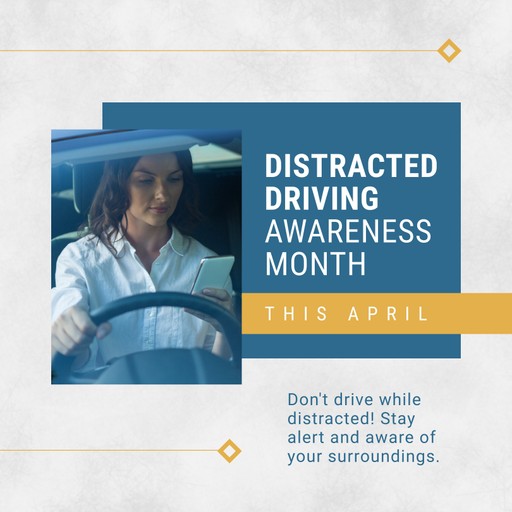
Every April, the National Highway Traffic Safety Administration designates the month as Distracted Driving Awareness Month. The goal is straightforward: focus national attention on one of the most preventable causes of serious traffic crashes in the United States.
In Florida, this conversation is not abstract. The state consistently ranks among the worst in the nation for distracted driving crashes. If you drive in Miami-Dade or Broward County, you almost certainly share the road with distracted drivers every single day. Understanding what that risk looks like — and what to do when a distracted driver causes a crash — is information worth having.
What the Data Actually Says About Distracted Driving in Florida
The Florida Department of Highway Safety and Motor Vehicles tracks distracted driving crashes separately from other crash categories. The numbers are consistent, and they are not improving meaningfully.
Florida averages more than 50,000 distracted driving crashes annually. Those crashes result in thousands of serious injuries and hundreds of fatalities each year. Distracted driving is listed as a contributing factor in approximately one in five crashes statewide — and that figure likely undercounts the real rate, because distraction is notoriously difficult for officers to confirm at a crash scene.
In Miami-Dade and Broward counties specifically, crash density is already extreme. Miami-Dade records more than 60,000 crashes per year across its road network. Broward adds tens of thousands more. These are two of the most congested, highest-traffic counties in the country, and distracted driving inserts an additional variable into an already high-risk driving environment.
The NHTSA defines distracted driving in three categories:
• Visual distraction — taking your eyes off the road
• Manual distraction — taking your hands off the wheel
• Cognitive distraction — taking your mind off the task of driving
A cell phone in use behind the wheel typically involves all three simultaneously. That’s why NHTSA research consistently shows that phone-related distraction carries crash risk equivalent to driving with a blood alcohol level above the legal limit.
Florida Law and Distracted Driving
Florida enacted a hands-free law in 2019 that prohibits handheld phone use while driving in school zones and construction zones. As of 2020, it became a primary offense statewide — meaning officers can stop and cite a driver solely for handheld phone use, without needing another traffic violation as a basis.
The practical effect of this law has been modest. Enforcement is difficult. A driver can claim to be using a phone for navigation — which is permitted — rather than texting or scrolling social media, which are not. The result is that distracted driving rates have not declined dramatically since the law’s passage, even as awareness has increased.
What the law does do is create a clear legal record when a distracted driver causes a crash. A citation for handheld phone use at the scene of an accident is documentation that matters for insurance purposes.
The Injuries Distracted Driving Crashes Produce
Distracted driving crashes often involve a driver who does not brake at all before impact, or who brakes only in the final fraction of a second. This produces impact dynamics that differ from crashes where both drivers had time to react. The injured occupant’s body absorbs a force that their body had no time to brace for.
The injuries that follow are consistent with high-energy whiplash mechanics:
• Cervical spine injuries — ligament sprains, disc herniations, and nerve compression at C5-C6 and C6-C7 are the most common levels affected in rear-end and side-impact crashes
• Thoracic and lumbar spine strain — the mid and lower back absorb rotational and compressive forces during impact, particularly in occupants who were turned or reaching at the moment of collision
• Soft tissue injuries to the shoulders and upper extremities — common in drivers who had hands on the wheel at impact
• Concussion and mild traumatic brain injury — even without direct head impact, the rapid acceleration-deceleration of a crash can cause neurological symptoms that may not appear immediately
A consistent feature of these injuries is delayed symptom onset. Adrenaline at the scene suppresses pain signals reliably. Many people involved in distracted driving crashes feel fine in the immediate aftermath and report significant pain and stiffness within 24 to 72 hours as inflammatory processes develop.
This is medically normal. It is also why Florida’s PIP law is structured the way it is.
The 14-Day Rule and Why It Matters Here
Florida’s Personal Injury Protection law requires that you seek medical evaluation within 14 days of a crash to preserve your PIP benefits. That clock starts at the moment of impact, not when symptoms appear.
For distracted driving crashes specifically, the delayed symptom pattern makes this rule critically important. Someone who feels “fine” after being rear-ended by a distracted driver on I-95 may not experience significant neck or back pain until day two or three. If they wait until symptoms become severe before seeking care, they may find themselves outside the 14-day window — with significantly reduced or no PIP coverage for the treatment they need.
Florida PIP provides up to $10,000 in medical coverage if the treating provider documents an Emergency Medical Condition. For injuries that do not meet the EMC threshold, coverage is limited to $2,500. Getting evaluated promptly — and thoroughly — is what allows your provider to document your injuries accurately and ensure your coverage reflects the full extent of what occurred.
What to Do If a Distracted Driver Hits You
The steps that protect your health and your PIP claim overlap significantly. In the immediate aftermath of a crash:
• Stay at the scene and call 911. Request a police report even for low-speed collisions. If the other driver was cited for phone use or cited at the scene, that documentation is important.
• Do not say you are uninjured at the scene. You cannot reliably assess your own condition immediately after a crash. Adrenaline is a poor diagnostic tool.
• Photograph everything — both vehicles from all angles, the surrounding area, any visible injuries, and license plates.
• Seek evaluation within 14 days, and sooner if possible. Same-day evaluation is available — you do not need to schedule weeks out.
• Keep a symptom log. Note when pain, stiffness, headaches, or cognitive symptoms (brain fog, difficulty concentrating) appear and how they change day to day. This documentation is useful for your provider and your claim.
You do not need an attorney to begin treatment. Your PIP coverage applies regardless of who caused the crash — that is what no-fault insurance means in practice. You can seek care first and address the legal dimensions of your situation afterward if you choose to.
Distracted Driving Awareness Month: What It’s Really About
The awareness campaign matters because distracted driving is entirely behavioral. Unlike road design deficiencies or mechanical failures, it is a choice that a driver makes — often repeatedly, often at highway speeds — that puts everyone around them at risk.
The data from Florida is a reminder that this risk is not hypothetical. It is distributed across every commute, every school zone, every interstate interchange in Miami-Dade and Broward. If you have been driving in South Florida for any length of time, you have almost certainly had a near-miss with a distracted driver. Some people are not as fortunate as a near-miss.
If April’s awareness month prompts anything useful, it is the combination of driving more defensively yourself and knowing what to do in the event someone else’s distraction affects you.
📍 County Line Chiropractic · Six South Florida Locations Miami Gardens · North Miami Beach · Pembroke Pines · Plantation · Lauderhill · Oakland Park Walk-ins welcome. Same-day evaluations available. We bill your PIP insurer directly — no upfront payment required. No attorney required to be seen. Call or schedule at countylinechiro.com |
This content is for educational purposes only and does not constitute legal, medical, or insurance advice. Florida PIP coverage amounts, co-pay obligations, and benefit limits vary by individual policy. Consult a licensed Florida healthcare provider, insurance professional, or attorney for advice specific to your situation. If you are experiencing a life-threatening emergency, call 911 immediately.